


Caffeine and hot flashes


 True confession: I hated reading this study and I truly dislike the findings. But I feel obligated to share what I’ve learned about caffeine and menopause, if only to provide you with additional options for symptoms management. If you are a long-time reader of Flashfree, you will remember that I’ve previously covered the health benefits of coffee so the news isn’t all that bad. However, if you are experiencing frequent hot flashes and night sweats, you may want to considering cut down on your daily consumption.
Recently, researchers at the Mayo Clinic in Rochester, MN surveyed over 1,800 women who visited the clinic for menopausal complaints. The women were asked to respond to a scientific survey — the Menopause Health Questionnaire — that assesses a variety of important factors such as demographics, reproductive/gynecologic histories and the presence/severity of symptoms. With regard to caffeine intake, the women were asked if they consumed drinks with caffeine (e.g. coffee, tea, soft drinks) and current smoking status was also evaluated. Because of the subjective nature of pre- and perimenopause, these women were grouped and then compared to women who were in full menopause.
Although the use of self-reported questionnaires always introduce possible bias for skewed study findings, it’s important to note that compared with women who did not use caffeine, caffeine users scored higher for vasomotor symptoms. Moreover, even after the researchers accounted for possible confounding factors such as smoking and menopausal status, ingesting caffeinated beverages was still significantly associated with an increase in bothersome hot flashes and night sweats. Evidently, caffeine use did not affect other common symptoms, such as sleep issues or sexual function).
A possible explanation lies with way that caffeine possibly interacts with the body’s estrogen; for example, it may inhibit an enzyme that converts the hormone androgen into estrogen. Another theory is that is affects the levels of other sex hormones, such as testosterone. Regardless, if you are experiencing frequent hot flashes and night sweats and have come to your wit’s end, you may want to consider how you are using caffeine. Breaking up is hard to do but it may save you a drop or two of that sweaty, hot stuff!
Read More
Just an application a day…
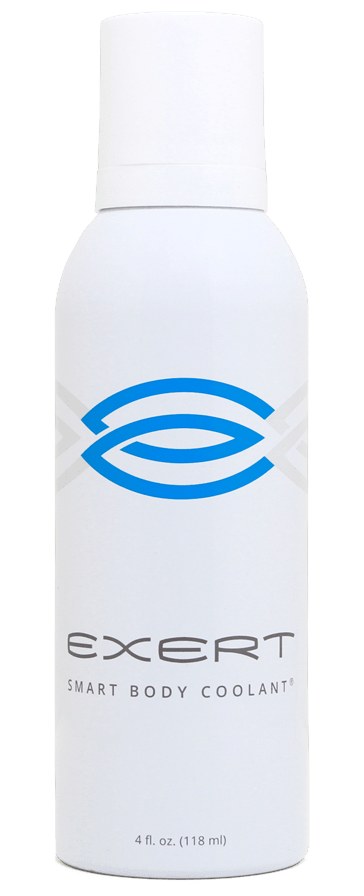
Keeps the flashes at bay???
When the folks at Exert contacted me on Twitter about their Smart Body Coolant, I wanted to believe, I truly did. However, what I’ve found after a week’s use is that the product simply does not live up to its claims, at least, not for me.
Exert’s Smart Body Coolant is a once-daily body spray composed of phase change and high thermal conductivity materials. Theoretically, it promises to draw heat away from the body much like a wicking fabric, reducing temperature by as much as 2 to 6 degrees. And there’s no need for additional application after a flash; it supposedly ‘recharges’ once the skin drops to optimal temperature.
Admittedly, I have been experiencing lots of undesired heat of late, both during the night and while at the gym and so, another alternative to HRT certainly appeals. But, Exert did nothing for me. Further intrigued by its lack of effectiveness, I delved deeper into its ingredients. Here’s what I learned:
- A phase-change material (PCM) is a substance with a high heat fusion that absorbs or releases energy or heat, when the material changes from solid to liquid. So, when you start sweating, it should be working to release the heat.
- Thermal conductivity refers to how well certain materials transfer heat
- Together, these should equate to cooling.
Except, they don’t.
Look, Exert is well priced and should last up to six weeks with daily application. The application part of this equation lives up to its promises: nongreasy, unscented and non-staining. And, while I remain skeptical about its effectiveness, others’ testimonials are not quite so negative so clearly, there is either a placebo effect at play or it’s working for some. My advice? I don’t believe the hype but at the same time, it’s always worth trying, right? Kudos to the company for a unique idea but spraying flashes away is not in my future. Is it in yours’?
[Disclosure – I was not paid for this review but I did receive a can of Exert care of the company’s representatives.]
Read MoreWednesday Bubble: Time for some scuba gear!

Readers:
I am on holiday through Labor Day so today, I leave you with a link to the archives; the topic is night sweats!
Hopefully, you’ll find some gems and your partner can lose his scuba gear!
Cheers!
Read MoreNewsflash: Ethnic, flashing and menstruating. Three’s a charm?
 Sounds too awful to be true. However, a study of an ethnically diverse group of women has shown that having regular periods, which, theoretically indicates that hormone levels are more on par than their menopausal sisters, may not be all that they are cracked up to be. In fact, among approximately 1,500 women (mean age 48.5), 54% reported having had either hot flashes (~33%) or night sweats (~46%) at some point and recently, anywhere from 17% (hot flashes) to 26% (night sweats). Moreover, it appeared that Black and Native American women were most vulnerable, while Asian women were the least. The numbers among white women were only slightly lower than their Native and Black peers.
What’s so interesting about these data is that typically, obesity has been associated with a self-reported increase in vasomotor symptoms among menopausal women. However, in this group of women, the researchers deliberately adjusted their findings for BMI and age, and they did not find that association. In fact, when they looked at Hawaiian/Pacific Islander women, who had, on average, the highest BMI of all the ethnic groups studies, only 45% reported ever having a hot flash or night sweat, compared to 58% of white women (who had some of the lowest BMIs amongst the group).
Why it matters…
Many women operate under the assumption that it won’t happen to them. Cancer won’t happen. Losing a spouse won’t happen. Having a hot flash or night sweat while still menstruating won’t happen. I refer to that as the ‘teenage mindset,’ since we all know that teenagers are among the most prone to the ‘won’t happen to me’ syndrome. And yet, the data suggest otherwise; even before menopause starts, a hot flash can occur. And it can be bothersome; of the entire group of women who said that they had had some sort of vasomotor event in the prior two weeks, anywhere from 38% (Asian women) to 80% (Hawaiian/Pacific Islander, Native Americans) said it was at least moderately bothersome. White and Black women fell in the middle.
I cannot emphasize it enough; early action is the best action. Don’t wait until you are in the throes of menopause; start now to boost your preventive strategies, whether they entail isoflavones, hypnosis, yoga or acupuncture. I am all for curtailing the worst wherever possible; shouldn’t you be?!
Read More
Black cohosh: dose matters
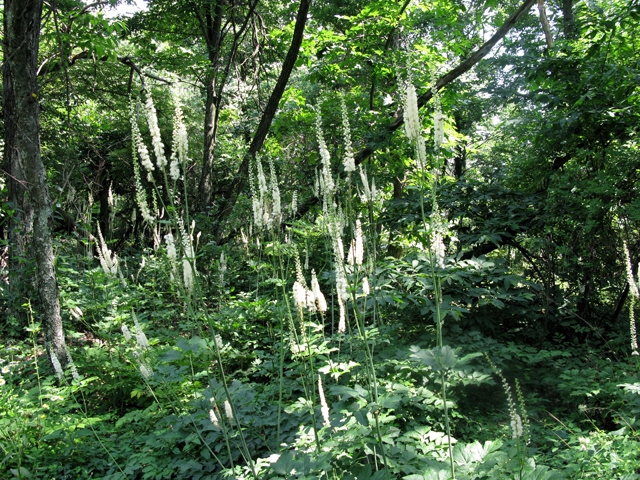
[Image: Thomas L. Muller, The Lady Bird Johnson Wildflower Digital Image Library at the University of Texas, Austin]
I have written frequently about black cohosh on Flashfree. And consistently, the relationship between black cohosh and a decline in certain symptoms has been demonstrated in clinical trials. However, here’s the rub: both formulation and dose appears to matter.
About a year ago, findings from scientifically sound (i.e. randomized, controlled, double-blind) trial demonstrated that taking the higher dose formulation of a black cohosh extract (Ze 450) yielded greater benefits in terms of symptoms severity and quality of life in A group of menopausal women. However, what happens over the long term? Do symptoms reappear or do improvements continue? And, is it really true that dose matters?
In a follow up study, researchers selected over four hundred women with menopausal complaints who were seeing about 100 physicians in general and specialty practices. Initially, these women were treated with a high dose of black cohosh root extract (13 mg) for 3 months and either continued with that dosing for another 6 months or were told by their physician to take a smaller, 6.5 mg dose for 6 months. Overall, a majority of women had moderately severe symptoms (most commonly hot flashes, night sweats, insomnia, anxiety and depression) and about two thirds had received previous treatment for them. Importantly, none of the women taking concurrent hormone therapy were included in the final evaluation.
Over the course of 9 months, black cohosh extract significantly decreased symptom severity by roughly 56% as measured by a scientific menopause scale. More improvements continued to be seen over time, regardless of dose. However, almost 90% of women responded to the high dose extract versus 78% of women responding to the low dose; this suggests that greater benefit can be realized among greater numbers of women with a higher dose. Indeed, women taking the high dose, experienced improved relief of a variety of symptoms (e.g. hot flashes, sweating, dizziness, joint and muscle pain, etc) over time. Both doses were also well tolerated in about 95% of women, although the higher dose was associated with some gastro issues in 12 women).
Another interesting point about this study was that it was conducted in what researchers refer to an ambulatory setting, meaning that it was not a controlled trial situation. Because similar results were observed under controlled conditions, conducting the extension under a more realistic environment allowed them to draw the conclusion that the findings reflected those that would likely be seen in the general population.
The black cohosh extract used in these studies is called Cimefemin® uno (6.5 mg) and Cimefemin® forte (13 mg) and is not available in the States, at least not yet. Meanwhile, if you wish to try black cohosh, read through the archives, speak to your practitioner and used a standardized formulation. It looks like it’s a win-win.
Read More
Newsflash: MsFLASH needs participants
I know, it’s Wednesday and you are probably thinking that I’m taking a mick; who else would be Ms. FLASH than me, right?! However, this is a bonefide ask and post. MsFLASH –Menopause Strategies: Finding Lasting Answers for Symptoms and Health (MSFLASH)– is a network of studies evaluating potentially promising treatments for common menopausal symptoms. Started by the National Institutes of Health, MsFLASH comprises five research centers in Boston, Oakland, Philadelphia, Seattle and Indianapolis who are exploring various interventions for hot flashes, night sweats, mood disorders and sexual issues. Mind you, some of these studies are looking at pharmaceuticals so they might not be appealing. However, if you are a woman between the ages of 40 and 62, going through the pause and experiencing frequent symptoms, you may wish to consider participating.
My goal is and has always been to further our understanding of the challenges of menopause and exploring viable strategies to address them. Without research, this is impossible and leaves only one avenue: hormone replacement. And we all know what a slippery slope that has proven to be.
MsFLASH may ultimately reveal nothing of value. Or, it may be five years times $4.4 million well spent.
Check it out. Who knows? You may be part of history in the making!
Read MoreArchives
Tags

This work is licensed under a Creative Commons Attribution-NonCommercial-NoDerivs 3.0 Unported License.