


Hot flashes, acupuncture and Traditional Chinese Medicine


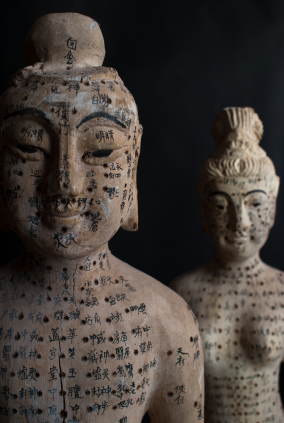
Acupuncture continues to top the list of ‘go to’ alternatives for hot flashes. And despite confusion, researchers remain focused on trying to explain (and perhaps overcome) conflicting study findings. That, my dear readers, is a very good thing, as this non-invasive, gentle treatment modality, while not the end all to be all, may one day become as accepted among Western practitioners as pharmaceutical agents are.
The goal of Traditional Chinese Medicine (TCM) and acupuncture as they relate to menopausal symptoms like flashes is to reinforce the kidneys, which according to TCM philosophy, result due to a decline in kidney yin and yang (think: out of balance). As I wrote a few years ago:
TCM and other similar philosophies emphasizes various body systems that together, form a network or grid connected by a meridien, if you will, as well as the relationship of the body to its social and natural environment. Its primary focus on maintaining health and enhancing the body’s ability to fight off disease. TCM will not focus, for example, on treating specific pathogens but rather, on addressing non-specific factors that create disturbances or imbalances within a certain network. TCM also examines how these imbalances may occur in unique parts of a specific system, such as the heart and blood vessels and small intestine (all of which are part of the heart system) and how they change over time. Western medicine, on the other hand, focuses primarily on treating morbidities, or symptoms related to various conditions and diseases. You can read more rabout TCM in this post from September, 2010.
In TCM, menopausal symptoms are believed to be related to a decline in yin or yang in the kidneys. One of the oldest prescriptions in TCM to reinforce kidney energy is known as ‘Qing E Fang’ (QEF) and the first record of its use dates back to the year 960. The preparation is a combination of four key ingredients that are mediated through estrogen receptors and expression, hence, its potential usefulness in menopause. (These ingredients, in case you are interested, are Cortex Eucommiae (whose bark and leaf have an antioxidant effect) Fructus Psoraleae (commonly used for bone health and to treat estrogen associated diseases), Semen Juglandis and Rhizoma Garlic.)
From a Western perspective, there is evidence (albeit preliminary) that suggests that acupuncture actually inhibits the thermoregulatory action of the hypothalmic-pituitary gland that works to create a hot flash. (You can read more about how a hot flash comes about here.) And when study trials are designed with TCM and acupuncture philosophy in mind, they tend to yield positive results – such as a small study that appears online in Menopause journal.
This time, researchers took four groups of women who experienced 20 or more hot flashes a week and assigned them to one of four groups: real acupuncture, sham acupuncture (needles inserted superficially), a 14 herb chinese formulation known as Zhi Mu 14 or a placebo version of the same. Women in all four groups were exposed to licensed practitioners and received TCM diagnoses. An important distinction in this research was that not only did the researchers predetermine 8 standard sites for needle insertion, BUT they also allowed the clinician to use an additional, individual points. In the sham acupuncture group, the acupuncture points corresponded to those used regularly in large clinical trials. Women using the Zhi Mu or the placebo took three capsules daily. And, all women maintained a hot flash and menopause symptom diary.
The findings are intriguing. While Zhi Mu did not appear to have much impact on hot flashes, acupuncture did, resulting in significant improvements in both hot flash frequency and severity as well as in other symptoms. Over the long term, acupuncture also appeared to attenuate bladder and sexual problems as well as joint and muscle aches and pains. Moreover, the findings also suggested that real acupuncture is superior to sham acupuncture in reducing severity and frequency of menopausal symptoms, much more so than other clinical trials. Importantly, the researchers believe that their results, albeit preliminary, are due to standardized plus individualized treatment performed by highly experienced acupuncturists.
Where are the holes? Well, this was a small group of women and Zhi Mu doses were not modified according to individual needs (as they might have been in the real world). They also did not test liver values at the end of the study (evidently Zhi Mu has been linked to liver toxicity in some women) so safety of this particular preparation was not properly assessed. Still, scientific jargon aside, this is what you need to take away from this information:
A very small study that was designed by Western practitioners within the parameters of TCM philosophies once again demonstrated the beneficial effect of acupuncture on hot flashes in particular. When acupuncture is conducted appropriately and by a highly skilled practitioner, positive benefits may be realized.
Before we jump to any future conclusions, it’s time to revisit and consider the value of alternatives for menopausal symptoms. Sometimes a spade simply is not a spade and there is more than meets the eye when you start digging through the details.
Read More
Wednesday Bubble: Two is the Magic Number?
When it comes to Traditional Chinese Medicine (TCM), is two the magic number? A variety of studies have examined the utility of TCM for menopausal symptoms and some have shown good benefit. However, does combining distinct forms of TCM yield better outcomes? Moreover, are these outcomes equal to those achieved by hormone therapy?
They may very well be, according to a small study that was presented this past May at the International Research Congress on Integrative Medicine and Health. Published in BMC Complementary and Alternative Medicine, the study explores the use of a Chinese herbal formulation named Kun Bao Wan alone and in combination with acupuncture and compares it to hormone therapy. Available in powder form and priced at approximately $8.00 a box, Kun Bao Yan is used in Chinese medicine to balance hormone levels, relieve insomnia and improve blood circulation to restore healthy metabolism. A web and database search yielded almost no information on side effects, reinforcing the need to work directly with a practitioner versed in Chinese medicine versus using it on your own.
Regardless, over a two-month period, 57 women in peri- or full on menopause took Kun Bao Wan (5 gm. twice a day) alone or in combination of 5 acupuncture sessions a month, or were assigned hormone therapy. During this time, symptoms (hot flashes, tingling, insomnia, nervousness, weakness, dizziness, palpitations) were measured with a scientifically validated index. The researchers also assessed hormone levels (FSH, estradiol) and symptom severity and frequency.
The findings appear to indicate that while all three strategies can significantly decrease menopause symptom scores, better results were achieved with Chinese medicine plus acupuncture compared to Chinese medicine alone, particularly in women who were postmenopausal. Additionally, Chinese medicine plus acupuncture was on par with hormone therapy with regards to its overall effects on FSH. Importantly, none of these strategies appeared to affect levels of circulating natural estradiol.
Granted, this study is quite small. But it does show that with Chinese Medicine, two combined modalities may be better than one. And are certainly on par with hormone therapy — and perhaps even safer.
Read More
Needles and symptoms and a pathway, revealed…more on acupuncture
Click on acupuncture in the tag cloud and you’ll know that I’ve spent a number of years examining and sharing information about important studies on this blog. In some, acupuncture has been shown to alleviate vasomotor symptoms like hot flashes and night sweats, and in others, acupuncture appears to be no better than placebo or sham needles that are placed on accurate points but not actually inserted into the skin. However, I’ve also long argued that by slightly changing the way that we conduct scientific studies in the West and allowing for individualization, observed benefits might be different. Indeed, that’s exactly what researchers have seen with ACUFLASH and you can read more about that trial here.
Less clear that whether or not acupuncture can help symptoms (for the record, I am biased and I believe that over time it can), is HOW it works. The centuries old Chinese medicine paradigm is never so apparent than with acupuncture and although I am not sure why we need to know the ‘how,’ I am fairly certain that until it is revealed, there will be a lot of researchers and health practitioners questioning its validity or utility.
So, this brings me to a wonderful pilot study in the online version of Menopause, exploring that very question: how does acupuncture work on vasomotor symptoms?
In this small trial, 33 perimenopausal and postmenopausal received traditional acupuncture, sham acupuncture or nothing over a period of 12 weeks. The active groups received three treatments per week and all the women reported having at least 7 hot flashes a day. But there’s the rub: the researchers also looked at how traditional acupuncture affected the hypothalamic-pituitary axis (HPA), the part of the body that comprises the hypothalamus and pituitary and adrenal glands, controls digestion, our immune system, mood and emotions, sexuality, and how energy is used and stored. Moreover, this part of the body reacts quite negatively to stress by releasing a hormone known as cortisol. Not surprisingly, women who have very severe vasomotor symptoms tend to produce high levels of cortisol.
What did they learn?
- Most of the benefits, (e.g. reductions in hot flashes) occurred by week five and; hot flash severity and frequency declined by 86% and 78%, respectively in both the real acupuncture and sham acupuncture groups. But while the sham acupuncture group didn’t continue to improve, the real acupuncture group did.
- Likewise, anxiety and depression improved in both of these groups, as did sleep scores.
And the “how?”
It appears, at least from this small study, that acupuncture positively affected levels of cortisol and DHEA, the major steroid secreted by the adrenal glands that affects none other than the body’s production of estrogen. Consequently, if acupuncture helps to control the HPA, and HPA affects vasomotor symptoms, then perhaps scientists have the first clue as to why acupuncture may help certain menopausal symptoms. It also opens up an entirely new avenue for novel strategies to control them.
The bottom line is that there is hope and a new direction that researchers will ideally follow. Ultimately, acupuncture may prove to be even more effective than pharmaceutical strategies for menopausal symptoms and definitely, much safer.
The jury’s still out but it seems a helluva closer to a verdict.
Read More
Depression and menopause: can acupuncture help?

Depression and menopause. It keeps coming up as a topic and so I’m going to continue to write about it until researchers find an effective way to battle depression during menopause, effective meaning that it is an acceptable strategy for women who prefer alternatives to pharmaceutical agents, effective in that it addresses the underlying causes of depression in menopausal women, including fluctuating estrogen levels, sleep disturbances, night sweats, hot flashes and life factors, and effective in that it is affordable. It’s a tall order, isn’t it?
As I’ve noted time and again, depression is an important issue for many but not all menopausal women, affecting approximately 20% to 40% in a some way or another. Just this week, I wrote about use of the SSRI antidepressants as an alternative to HRT for hot flashes and depression, and possibly as a stop-gap measure until practitioners more widely embrace alternative strategies. On the heels of this study comes another in the Online Edition of Menopause journal, examining data from one of my favourite studies, ACUFLASH. If you don’t feel like clicking on the link and updates about this study, briefly, in ACUFLASH, researchers randomized 399 postmenopausal women (1 year since last menstrual period) regularly experiencing at least 7 hot flashes daily to acupuncture or no treatment. Moxibustion was used at the practitioner’s discretion and sessions could also be extended by two weeks (from 12 weeks), if needed. Although the practitioners met beforehand to discuss possible diagnoses and recommended treatment points, all treatment was individualized. Both groups of patients also received self care recommendations, which consisted of a one-page information leaflet on care of menopausal symptoms (e.g. soy, herbs, physical activity and relaxation techniques) which they were free to add at their own discretion.
Overall, the mean frequency of hot flashes declined by 48% in women receiving acupuncture compared with 28% of women using self-care methods only. This means that 50% of women receiving acupuncture experienced a 50% or greater reduction in how often their hot flashes occurred, compared to 16% of women using self-care. Significant reductions were also seen in hot flash intensity. Additionally, the acupuncture group reported significant improvements in vasomotor, sleep, and somatic symptoms over the course of the study.
So, what about acupuncture and depression?
In the current study, researchers examined a sample of 72 women who had participated in ACUFLASH and had either received self-care only or self-care plus acupuncture. At the start, almost 31% of these women reported depressive symptoms and of these, about 17% were determined to suffer from moderate to severe depression (based on a scientific method that measures the severity of depressive symptoms). Although these figures are higher than what is normally seen in the general population, severe depression is often seen among women experiencing very frequent hot flashes (7 or more in a 24 hour period for at least 1 week). And while both groups reported significant declines in depressive symptoms during the 12 week study period by as much as 16%, the declines were similar in both groups, indicating the acupuncture,while helpful for lessening the severity of hot flashes, did not have a specific effect on depression.
If acupuncture doesn’t help depression, why did the results indicate such a high level of improvement that under normal circumstances, an individual could forgo drugs for needles?
A key finding of the original and follow up ACUFLASH studies was the feeling of control over symptoms that was imparted by being educated about self-care. However, here’s the rub: even though acupuncture was shown to significantly benefit both the intensity and frequency of hot flashes, it didn’t provide an edge over depressive symptoms compared to self care alone. The researchers say that this leads them to believe that although a domino effect is at-play (i.e. hot flashes lead to sleep issues lead to symptoms of depression) there is something else that also influences the depression part of the equation.
In the interim, it’s frustrating, right? You can deal with your hot flashes but you still feel blue, low, out of sorts. There is clearly a link between the hot flashes and sleep and depression. It simply needs to be teased out a wee bit further. Keep the faith. We’ll get there!
Read MoreWednesday Bubble: Time to debunk the hype about traditional Chinese Medicine

This week is dedicated to the debunk – debunking the absolute need for anti-anxiety medications (it may be your flashes, not your mood), debunking the myth underlying the lack of published data supporting the use of traditional Chinese Medicine (TCM, e.g. acupuncture and herbal medicine) and debunking the one-sided, endless loop about hormone replacement therapy.
Because Wednesday falls in the middle of the week, I want to focus on traditional Chinese medicine, which is considered part of the offerings that fall under the umbrella of “complimentary and alternative medicine.” As a practice, TCM was created roughly two thousand years ago and refined in the centuries that followed. And yet, Western practitioners continue to question its value because they claim that there is no real evidence supporting its therapeutic effectiveness. No evidence? A quick search on Google yields countless databases, with one example housing over 400,000 studies and abstracts, many of which have been published in reputable Chinese biomedical journals over the past several decades.
The challenge and the solution
Unquestionably, the evidence doesn’t look quite as strong when strict Western methodology is applied to Eastern philosophies without addressing their distinctions. In fact, a prime example of what happens when the paradigm shifts is the ACUFLASH study, which as I reported earlier this year and late last, demonstrated the benefits of acupuncture when the investigator practitioners were allowed to incorporate some invidualized therapy into the mix.
So what exactly does that mean – to incorporate individualized therapy into the mix?
A unique aspect of the ACUFLASH study was the ability of the practitioners to work within a defined framework but with the addition of directing therapy to each participant’s specific needs. In other words, the practitioners met before treatment and agreed on the specific symptoms or conditions they would include in the study as well as the specific acupuncture treatment points they could work on. This organized system meets some of the strict criteria of Western scientific study. However, they could then choose which of the the treatment points would most benefit a given participant’s system imbalance as well as provide possible diagnoses and self care recommendations (e.g. soy, herbs, physical activity and relaxation techniques) which participants were free to add at their own discretion. This ability to work within the confines of both Western and Eastern practice resulted in significantly beneficial results.
TCM versus Western Medicine
TCM and other similar philosophies emphasizes various body systems that together, form a network or grid connected by a meridien, if you will, as well as the relationship of the body to its social and natural environment. Its primary focus on maintaining health and enhancing the body’s ability to fight off disease. TCM will not focus, for example, on treating specific pathogens but rather, on addressing non-specific factors that create disturbances or imbalances within a certain network. TCM also examines how these imbalances may occur in unique parts of a specific system, such as the heart and blood vessels and small intestine (all of which are part of the heart system) and how they change over time. Western medicine, on the other hand, focuses primarily on treating morbidities, or symptoms related to various conditions and diseases.
Another point of distinction is that while Western practice is geared towards treating specific causes and symptoms of a disease, it doesn’t do so well when the causes or influences are less specific or more importantly varied. Sexual desire, or lack thereof, is a perfect example. It’s been demonstrated time and again that certain aspects of menopause or aging, for example, sexual desire, are not only related to physiology but also to environmental factors. And while the addition of estrogen can certainly help to keep vaginal juices flowing, so to speak, it can’t address social, psychological or behavioral factors that might also be influencing that desire.
I have said it before and I’ll say it again: my dream will be fulfilled when East meets West. I’d like to see greater integration of of the two philosophies and less push back from the Western Medical Establishment against TCM. Calling it a ‘sham,’ because it doesn’t fit into the traditional mold, calling it snake medicine because it isn’t based on medical school learnings, and refusing to examine published scientific papers that have been translated, however roughly, into English, does a disservice to the patients who might benefit from the integration of the two.
Since when are hot flashes and mood swings ‘pathologies,’ symptoms of a disease that requires drug treatment?
Isn’t it time to separate fact from fiction, hype from hope and myth from truth. TCM isn’t a sham. And menopause? It can truly be addressed without drug therapy.
Read MoreArchives
Tags

This work is licensed under a Creative Commons Attribution-NonCommercial-NoDerivs 3.0 Unported License.