


Get a jump start on those resolutions: eat like a woman


It’s the day after the American Thanksgiving when many of us have indulged beyond the pale, entered food coma land and may even be contemplating another piece of pie for breakfast. Hey, I am all for it! I typically bring the most decadent dish that I can think of; this year it was grits dressing which I refer to as ‘cholesterol’s nightmare!’ Seriously, is there anything better than grits, cheddar cheese, eggs, cream and butter? Throw in a few chives for the nutrition aspect of the dish and voila! HEAVEN!
However, I don’t eat like this daily and I while I do indulge, I try to be mindful of what I’m putting into my mouth. And so, why not take the day after Thanksgiving to get a jump start on your New Year’s resolution?
I wrote this back in May when Staness’ book first came onto my radar but I do believe that it’s worthy of a second go, particularly since it is ‘that time of the year’ when indulgence rules the day. And so, once again, I must thank Staness for her diligent, thorough research and for her words of wisdom.
Consider this: when it comes to science and research, women have long gotten the short of end of the stick. Not only have women been historically excluded from medical research trials, but despite National Institutes of Health regulations mandating the inclusion of women and minorities in studies in order to obtain funding, research on women’s health has continued to lag behind their male counterparts’. Only recently has this issue reared its head again as findings from March, 2014 The Women’s Health Summit demonstrate important disparities in the scientific process that highlight one of the most important issues facing women today:
“When we fail to routinely consider the impact of sex and gender in research, we are leaving women’s health to chance. The evidence on sex differences in major causes of disease and disability in women is mounting, as are the gaps in research.”
Not only are women routinely excluded from research on cardiovascular disease (despite its ranking as the number one killer of women, only 1/3 of clinical trials enroll women and only 1/3 report on sex-specific outcomes), but, women suffer twice as often from depression and yet, fewer than half of laboratory studies utilize female animals to evaluate metabolic differences. And these examples are the tip of the iceberg!
So, it’s no surprise that these gender differences also affect nutrition.
As my friend and menopause colleague Staness Jonekos points out in her new book, Eat Like A Woman (and never diet again): 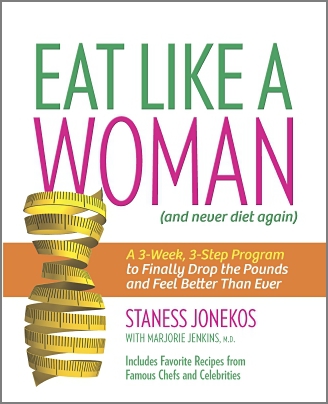
- It takes women’s stomachs an hour longer than men’s to empty after eating.
- For the most part, women have lower energy expenditure than their male counterparts due mostly to differences in body composition; notably, estrogen plays a major role in energy expenditure, appetite and body weight. An imbalance in hormones that are secreted by one gland can affect hormone levels in other glands.
- The thyroid, which Staness refers to as the ‘Metabolism Mama,’ is important for metabolism, energy, grown and development and the nervous system. When it’s out of whack, it can wreak havoc on weight, appetite and even mimic the symptoms of menopause. Moreover, research has demonstrated a direct interaction between estrogen and direct expression of thyroid sensitive genes; what this means is that if you are using hormones to manage your menopausal symptoms, you’ll want to have your thyroid checked.
- Cortisol, which I’ve written about frequently on Flashfree, is another important player. Produced by the adrenal glands,its primary role in the body is to regulate energy (by producing blood sugar or metabolizing carbohydrates, protein and fats) and mobilize it to areas where is it most needed. Research has shown, however, that women have higher cortisol levels than men, and that certain women –especially those with greater amounts of abdominal fat — may be reacting to a large disruption in the release of cortisol that causes a greater than normal difference between morning and evening levels of the hormone. This disruption is believed to be related, at least in part, to exposure to prolonged physical and mental stress. The psychological component is huge, because it tends to trigger the desire to consumption of food that is high in fat and/or sugar, which also tends to promote abdominal weight gain.
- Staness also writes about the role of neurotransmitters, chemicals released by nerve cells that carry messages between the brain and organs. They can affect mood, appetite, sleep, heart rate, appetite and weight, among other functions. Poor dietary habits (low intake of dietary protein, poor carbohydrate choices or minimal omega-3s, for example) coupled with hormonal imbalances and excessive alcohol or caffeine can lead to neurtransmitter imbalances. The bottom line? Hormonal changes may affect the actions of neurotransmitters, which in turn, affect mood and lifestyle choices. Staness further explains that lifestyle habits can affect hormones, thereby affecting neurotransmitters. Think of an endless loop: chronic stress triggers cortisol, causes weight gain, cravings, affecting serotonin levels and thyroid functioning, which then influence metabolism, cholesterol, etc. WOW!
- Women’s digestion is also distinct from a man’s, in that we taste food differently. Staness explains that women are ‘supertasters,’ with varying sensitivities to bitter flavors depending on hormone levels. Women also have a higher risk for irritable bowel syndrome, acid reflux, acid related ulcers and other conditions due to the size of the esophagus, small intestine, colon and rectum.
Staness writes that “there are many confusing messages about what to eat or not eat surrounding us,” and she poses a critical question: “how can one message or one plan apply to everyone? We are all different and yet our basic needs as women are the same.” Toward that end, she offers up a dietary plan that supports women’s health through each life stage and addresses various dietary controversies, ranging from soy to animal protein to salt to caffeine. And, she reintroduces the food pyramid that she says, is one of the biggest factors contributing to the success of her previous book, The Menopause Makeover. Notably, for all you paleo people out there, the ratios that Staness recommends are similar to the average portions consumed by our Stone Age relatives. The key?
- 25% of your calories should come from healthy fats
- 35% of your calories should come from low-fat, lean protein
- 40% of your calories should come from low- to medium-glycemic carbohydrates
Staness’ program is served up in three steps that includes approaches to meals, healthy emotions and exercise. However, she doesn’t stop there; she’s reached out to her favorite celebs and chef for recipes that should please any palate. And if you are seeking even more information, Staness offers additional tools and resources on her website .
What do you get when you combine sound science and nutrition? A plan that makes eating make sense…for women. Isn’t it time to change the paradigm? This seems like an awfully great place to start.
About Staness…
Staness Jonekos is an award-winning television writer, producer, and director, as well as an author and writer on women’s health issues. Her first book, The Menopause Makeover, was a pioneering work in the field of menopause, a highly visual and inspiring survival guide that challenged the conventional, old-style approach to managing menopause. She is a tireless advocate for women’s health, wellness and empowerment. She has appeared on The Today Show, contributes to The Huffington Post, and has been featured in a variety of publications ranging from The Houston Chronicle to More.com. Her co-author, Marjorie Jenkins, MD, FACP is a Professor in the Department of Internal Medicine, Division of Gender-Specific Women’s Health Director and Chief Scientific Officer, Laura W. Bush Institute for Women’s Health Associate Dean for Women in Health and Science. Her motto? “You have to know the difference to make a difference.”
Read More
Five a day for mental health and wellbeing
Have you been sensing a theme on Flashfree of late? I can’t help gravitating toward stories about mental wellbeing and reducing stress, namely because I have devoted the past few months toward regaining some semblance of balance after years of residing in the opposite flow. And so, once again, I do hope that you’ll allow me to indulge and share some pretty fascinating data:
Eating fruits and vegetables daily is associated with an increased odds of mental wellbeing in both men and women.
Mind you, researchers have not yet proven cause and effect. Yet, the data are pretty compelling! In fact, when British researchers evaluated certain influencing health-related factors in almost 14,000 British respondents participating in the Health Survey for England, they found that consuming (or not consuming) fruits and vegetables daily was the one health behavior that was most consistently associated with both high (and low) mental wellbeing in women and men.
Which other factors did they take into consideration?
Additional health-related behaviors that have been linked to mental health include body mass index, smoking habits and alcohol intake. In this case, Individuals who rated the lowest in terms of mental wellbeing tended to be obese, heavy or ex-smokers, never or ex-drinkers and reported eating the fewest daily servings of fruits and vegetables. Moreover, the the odds for having a lower overall mental wellbeing appeared to have increased exponentially with increasing smoking habits and decreasing fruits and vegetables intake.
Despite these factors, only intake of fruits and vegetables remained relevant and significant for both men and women; different BMI levels or alcohol intake had little bearing. What’s more? These findings tended to be more consistent for women than for men.
Let’s break down the numbers:
- Overall, 33.5% of individuals with high mental wellbeing ate five or more portions of fruits and vegetables daily
- 6.8% of people with the lowest mental wellbeing who reported eating less than one serving daily
- 31.4% with high wellbeing consumed three to four portions daily
- 28.4%of people who ate one to two servings a day had high mental wellbeing
It’s truly linear, isn’t it?
So, what is mental wellbeing?
Think all of everything. It’s more than the absence of mental illness or some sort of psychological issue. Indeed, its implications are huge: mental wellbeing comprises completeness, full-functioning, life satisfaction, optimism, hope, self-esteem, resilience, coping, spirituality and good relationships. Think of the implications should fruits and vegetables be identified as something that actually drives mental wellbeing rather than contributes to it. An easy, enjoyable fix? Five a day? I’d say!!
Read More
Guyside: Breaking good
 I’m a pretty lucky person. While my life isn’t perfect, I have many advantages, and I’m thankful for them. It’s easy to forget about that when you get focused on some problem or other.
But sometimes good enough shouldn’t be, you know?
Think about Walter White, a/k/a “Heisenberg” of Breaking Bad. He was a guy who had a “good enough” life — wife, son, baby on the way, a steady job that is respected, if not well-paying… and then a diagnosis of terminal lung cancer shattered everything in his life and forced him down a radically different path.
I’d be perfectly happy if not one person ever got diagnosed with lung cancer. And, for that matter, if people stopped making and using crystal meth. But I think that we don’t have to “break bad” — why not “break good?”
I’ve been trying to change some of my routines recently. For example, since I work from home I do most of the dinner preparation for the household. It’s the sort of thing that can make a break from staring at the computer or talking on the phone. And, like most people, I have a repertoire of dishes that I know well enough to essentially make without a great deal of thought.
So to break that up, I’ve started to search out new recipes, new ideas. It’s fun to try (especially when they work out well), and it breaks me out of the cooking rut and both me and my partner out of the taste-rut. Example: it being summer, coleslaw is a natural side dish for things we cook on the BBQ. I was used to buying bagged coleslaw from the store, then dressing it with a commercial dressing. Somehow I realized that hey, coleslaw’s just a few shredded veggies. So I started making my own. Then I tried some dressing recipes. WAY better than before. (FYI: I’ve become quite fond of this dressing recipe, with a few variations. Try it.)
I’ve changed other things recently too. I love beer. But having that end-of-day beer or the beer with supper, or the finished-the-yard-work beer can become a little … routine. So for a few weeks now, I’ve haven’t been bringing beer into the house. Now, when I have beer — like I did yesterday during an end-of-day business meeting, or like I did when I was visiting family recently — it’s DELICIOUS. At some point, I’ll likely restock the fridge, whenever I get the desire to do so.
There are all sorts of little routines that we establish in our lives. Many of them are there for very good reasons. We get up and shave and shower because we like being clean. We brush our teeth because we want our breath fresh and we don’t like cavities. But changing habits can be good for you. It stimulates your brain. It can make you think about the reason behind the habit. And that’s never bad.
Look at the routines of your day — the way you interact with people in your life, what you eat, drink, how and when you exercise, your activities, your leisure, your work. Pick one to play with, to try to change.
A lot of meditation practices focus on mindfulness — on simply being aware of your circumstances. If you feel good, note it. If your knee is sore, note that. If you want another cup of coffee, be aware of the desire. Assessing the little routines, experimenting by breaking one of them for good, and seeing if it improves your daily life — that’s part of mindfulness too. And failing is part of changing habits too. If you don’t like a change, or you can’t stop biting your nails, or whatever — just note that. Don’t beat yourself up over it.
Try it, just for fun.
Read MoreIs daily stress adding to weight gain?
 According to a newly published online study, stress may be wreaking more than havoc on our bodies than previously reported. And, it’s quantifiable…at least with regard to weight gain.
I have certainly covered the impact of daily stressors on the hormone cortisol (think: craving comfort food, higher insulin levels and a midsection fat dump). However, study findings demonstrate that if women experience one or more stressful events the day before eating a fat-laden meal, it may slow the metabolism in such a way that over time leads to a whopping 11 extra pounds a year! Is prevention the best cure? Here’s what you need to know.
A bit of background…In this study, researchers asked fifty eight women to sample two separate calorie and fat dense meals consisting of eggs, turkey sausage, biscuits and gravy (940 calories, 60 g fat total, with the difference between the two meals saturated versus monounsaturated fats). To level the playing field and neutralize any possible factors that could affect the results, they were asked to forgo physical activity and alcohol, as well as vitamins and antioxidants in days leading up the study; they also fasted 12 hours after consuming three, standardized meals. On the day of the study visit, they completed several questionnaires assessing depression, physical activities and the degree of stress during the day before. Most of the stressors that the women reported were fairly common and interpersonal, for example arguments with colleagues or spouses, disagreements with close ones or work issues.
What they found….the more stressors that women reported having had experienced the day prior to the meal, the slower the metabolic rate and the higher the insulin levels following the fatty meal. (Metabolic rate refers to the amount of time required to burn calories and fat; insulin contributes to the way fat is stored.) More stress also meant less conversion of fat into fuel, meaning that these women were storing more fat. What’s more, the combination of depression history and a large number of stressors caused both an immediate spike in triglycerides following the high fat calorie meal and a two-fold slower decline in cortisol levels. Additionally, type of fat didn’t appear to influence these findings; regardless if it was saturated or monounsaturated, stress affected metabolism fairly equally.
One of the most interesting take-aways from the study is that the high -at, calorie-dense meals that the women consumed are equivalent to many common fast food choices, for example, a MacDonald’s Big Mac with cheese and medium fries provides 930 calories and 58 grams of fat. And, the researchers note that while most people eat every four to five hours, the women were only provided with one meal; this means that food choices appear to influence metabolic rates all day long. Yet another reason to keep healthy foods nearby when stressors hit.
Read MoreGuyside: Chocoholic?
Oh, chocolate, you undo me.
I have a thing for chocolate. I love to eat it. Normally, this wouldn’t be a problem, right? Most people love chocolate. In the UK, people eat nearly 25 pounds of it every year. Here in North America, the average Canadian or US citizen eats lots less – about 11 pounds or so, but that’s still a lot.I figure if I quit, that average would go down by a pound or so.
With the gourmetization of everything, you’d think that this would be a good thing – consuming dark chocolate, with all those anti-oxidants and flavonoids is supposed to be good for you. But I have a taste – a craving – for the milky stuff. No nuts, no nougat, just good old milk chocolate. Perhaps it comes all the way from my childhood, when I used to have a big glass of Nestlé Quik for breakfast.
So when I think about how much chocolate I consume – bars, ice cream, gelato, etc. – I know that I’m consuming more of it than is likely healthy for me. Surely there are people out there that share this problem.
The key to me is that if I recognize this as a problem, then it is, at least for me.
So I decided to look for some tips to break this down a little bit, because I don’t necessarily want to go cold-turkey-total-abstinence-never-shall-chocolate-touch-my-lips-again. I want to be able to enjoy it in more moderation.
A Harvard medical blog suggests that if you note these three characteristics, then you’re behaving in an addictive way:
- intense craving
- loss of control over the object of that craving
- continued use or engagement despite bad consequences.
Chocolate, the post tells us, stimulates brain responses similar to those produced by “real” drugs. Now, I haven’t sold my body yet for a Hershey bar, but I don’t like the craving. And I don’t plan on entering a rehab program. So what do the big heads at Harvard suggest?
They focus on a mindfulness-related technique: “The next time you feel the pull of chocolate, pay attention to it. But instead of automatically reaching for your preferred candy bar or fudgy ice cream, take a few moments to actively decide whether or not to indulge the desire. If you decide to have chocolate, focus on each bite, slowly, to extend the pleasure in it. If you decide to wait, enjoy the notion that you’re taking good care of yourself. (You can take the same approach to alcohol, cigarettes, and food in general if you are trying to lose weight.)”
I’m gonna give this a try. What techniques do you use to control food consumption?
Read MoreArchives
Tags

This work is licensed under a Creative Commons Attribution-NonCommercial-NoDerivs 3.0 Unported License.