


Flashfree…time for a new journey



Hello there! I’ve been gone for about four years but I’ve been eager to get the site back up and running to provide women (and men) access to six some-odd years of posts and information. In the coming weeks, the site will be undergoing a revamp and slight change in direction, a new journey, if you will. While we would like to believe in the utopian fantasy that health is created equally, and that health needs are likewise, the same between women, data suggest otherwise. Women of color have increased rates of hypertension (aka high blood pressure), diabetes, death from breast cancer, etc. And as you may know, menopause is a prime time for the body to go haywire and certain disease risks, elevate markedly. So, stay tuned as I have a few thoughts about devising content that is specific to women of color, in addition to content that applies across the gender spectrum.
Blogging may be dead. However the search for current information never goes away.
Welcome back!
Read MoreMidlife. I don’t see four letters, do you?
A few years back, I wrote this post and it’s become evermore truer the older that I become. And so, on a Monday, I pose one question to you:
Do you believe that midlife is a four letter word?!

“The cultural narrative provided for women at midlife is either medical and menopause oriented — hot flashes, osteoporosis, heart disease, the estrogen replacement therapy decision — or socially devaluing –“empty nest,” a fertility has-been, abandoned for a younger woman, depressed.”
Wow! I read this introduction to a study that was published in the journal Social Work in the late 90’s and it got me thinking: what’s wrong with this picture?
Is midlife truly nature’s death sentence, a curse, a crumbling foundation foretelling a life well (or not so well) spent? When does this characterization become a self-fulfilling prophecy? And what can we do, as midlifers, to reverse this image? After all, change has to start somewhere, right?
A perfect place to initiate change is from a place within and a place outside of ourselves — by distinguishing ourselves from generations of women who came before us (for whom a self-view was often seen as selfish and whose opportunity to work outside the home was often trumped by the lack of quality positions) — and by asserting and reasserting our identities.
Are these steps in-line with the study findings?
The researchers, who investigated midlife experiences of 103 women between the ages of 40 and 59 reported the following:
- Respondents expressed high degrees of well-being, with 72.5% indicating that they were “very happy” or “happy,” and 64.3%, that this time was “not very confusing” or “not confusing at all.” However, despite being happy, many women still found this time of their lives challenging.
- Women who reported being most satisfied in their lives had a family income of at least $30,000 or more (which in today’s economy, is roughly equivalent to a little over $40,000), had good health, had at least one confidante or group of friends, had a high self-esteem, were not prone to self-denigration, and had a benign super ego.
One particular discovery that I find intriguing was that the groups scoring both the highest and lowest in midlife satisfaction unanimously agreed that what they liked best about midlife was increased independence and freedom, including freedom from worrying what others thought and freedom to develop a self-identity.
Not surprisingly, what women disliked the most about being middle-aged were physical changes, i.e. decreased energy, gray hair, wrinkles and extra weight.
Women scoring the highest in satisfaction and well-being also stated that they disliked the divide between how they saw themselves and how they imagined society saw them (positively and unattractive, respectively). Also at odds was the fact that they felt that men of the same age were revered for gray hair and wrinkles and did not lose social value in the same way that women did.
So, what are the biggest take-away messages?
- What matters most is not what women have but what they do with it
- Women actively participating in their lives and looking forward to new opportunities were the most satisfied
- Having a social world or at least one confidante with whom to speak freely and honestly about themselves, and feel understood, was critical
- Three selfs were also essential to wellbeing: self-effectance, self-acceptance and self-esteem
I know that certain things have changed since this study was published, such as the fact that research dollars are now being diverted away from simply looking at midlife changes in men and broadly applying the results across the genders, towards exploring midlife changes and how they specifically affect women’s health. What hasn’t changed, however, is the invisibility factor, that somehow, women over age 40 are no longer relevant.
So this is what I say:
Be relevant. Take the reins and effect change. Take a chance, a plunge. Value yourself. Embrace your friendships and your life. Grieve your former self and celebrate who are you are and who you will become.
Michelle Shocked once wrote “When I grow up, I want to be an old woman.”
When I grow up, I want to be. What about you?
Read MoreThe Mommy Factor Redux
I was scrolling through my Facebook stream yesterday and came upon a post written by a woman I know via the social spheres. She was commenting on the fact that she was consistently asked why she only had one child, as if having only one was an indication that something was wrong or that she and her partner couldn’t handle more.
It’s all about choice. More importantly, the choices we make do not always require an explanation unless we choose to offer one.
A few years back I wrote the following post. I chose to resurrect it today because her post resonated deeply with me.
I’m fairly active on Twitter. And the other day, someone I follow and respect greatly tweeted the following:
Gaining a whole new appreciation for child-free by choice types and those without kids. Society views these women so very differently.
Data released by the Pew Research Center in 2010 demonstrated that childlessness is increasing in the U.S., with roughly 1 in 5 women past childbearing years currently childless. Although the research points to “never married” as a factor, it also emphasizes the power of individual choice, employment opportunities and most importantly, a growing opinion that ‘without child’ does not equate to ’empty life.’
I am one of those women who are child-free by choice. I am a statistic. And my life is not empty.
“But aren’t you afraid you’ll regret it someday?”
“Don’t you feel badly that you didn’t give your parents grandchildren?”
“Do you understand what you are missing out on?”
Guess what? I’m going to share a little known fact with you.
I became pregnant at a time in my life when I felt I was too unsettled to properly care for a child. A time when I was with a partner with whom I didn’t feel comfortable sharing parenting responsibilities. A time that was simply the wrong time. Period. And after that? I certainly weighed the pros and cons of having children, many times. However, I ultimately decided that I was happier without having children of my own.
Shocking isn’t it?
My experience might resonate with some of you. Others might disapprove of my decision. At the end of the day? It truly is about personal choice, responsibility and a close, close look at oneself. Not everyone is suitable for parenthood.
Just because you can, doesn’t mean you should.
My life has been filled and surrounded by children for almost two decades now. I am an Aunt to three wonderful, amazing nephews and spending time with them brings me more pleasure than I can adequately express. I am also a surrogate Aunt to the children of an old friend, and although I don’t see them quite as often as I would like, I recently came to the realization that their presence, however sporadic, enriches my experience as a human being and as a woman in ways, again, for which there are no words.
Now that I’ve passed my fiftieth year, and two years after I first penned this, I still don’t feel as though the decision to leave the childbearing to other women is one that I regret or will ever regret. I made the decision based on timing, circumstance and a nagging feeling that I wasn’t meant to have a child, at least not in this lifetime, that I had a lot to offer the children in my life in ways that didn’t include being their parent.
So the next time you see a woman walking down the street without a child, or find a couple moving in next door without children, it’s probably best to assume that it’s best if all bets are off. There are many reasons why women don’t have children. And although being a mother is the defining moment for many women I know, I know just about as many who’ve chosen to remain childless and have experienced (and continue to experience) alternative defining moments in their womenhood, their lives and their spirits.
It’s all about choice. I’m grateful to have had the ability to decide what is right for me, to make choices based on that ability. Not every woman does.
Read MoreWednesday Bubble: For da guyz – midlife metamorphosis
Equal opportunity blog? You bet. This post may have appeared a few years ago but it’s still as relevant today as then. You’re a man in midlife or approaching midlife. What are you yearning for? Now? Or then?
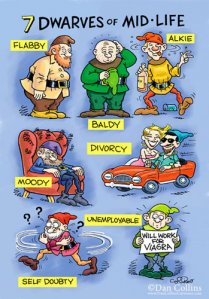
[Used with permission. Dan Collins. http://www.dancollinscartoons.com]
In Laura A. Munson’s poignant “Modern Love” post, ‘Those aren’t fighting words, dear” she writes about the crisis of self that may seem familiar to many in midlife who are watching or have watched their husbands or partners implode. In the post, (which I highly recommend if you’ve not read it) Laura writes:
And I saw what had been missing: pride. He’d lost pride in himself. Maybe that’s what happens when our egos take a hit in midlife and we realize we’re not as young and golden anymore. When life’s knocked us around. And our childhood myths reveal themselves to be just that. The truth feels like the biggest sucker-punch of them all: it’s not a spouse or land or a job or money that brings us happiness…
The premise that happiness comes from within is not a new one. However, the midlife spin on it can be a wake-up call of epic proportions, when we start reaching for a gold ring that actually resides out of sight. Yet, why are we yearning for what was rather than what is to be? Aren’t life’s many transitions, including the one that our partners and each of us are facing, movements into the next phase of productivity or change or growth, rather than a loss of self?
I’ve had many conversations with women who are facing or have faced situations that are similar to Laura’s. Overwhelmingly, they say that women tend to themselves a little at a time so that the crises never quite reach the precipice. That many women are able to deal with their physical and emotional changes incrementally so that the ultimate metamorphosis — who they are during and at the end of their lives — is not a monumental shock.
Dick Roth, in his wonderful book “No, It’s Not Hot in Here,’ devotes a chapter to men in midlfe. He says that men should repeatedly ask themselves three questions:
- What won’t pass away when my youth does?
- Who will I be after my career is over?
- Who would I be if everything else was gone but my mind and feelings?
Referencing the book The Diving Bell and the Butterfly, Roth adds that the protagonist’s lack of self-pity and ability to cherish his soul provided him with the foundation to overcome his physical confinement (the author, who was completely paralyzed by a stroke except for a single eyelid, was only able to communicate by blinking this one eye).
Cherish your soul. Sounds a lot simpler than it is. Or does it?
As much as we expect our partners to understand what we are going through as hormonal changes wreak havoc on our psyches and our bodies, we must also be willing to offer the reverse, to acknowledge the changes and struggles that our partners are going through, their self-confinement, and perhaps their inability to cherish or tap into their souls.
Midlife doesn’t have to be a four-letter word. What rings true for women, also rings true for men.
Seize it.
Read MoreSleep…still between the mattress, the pillow and a hard place

Sleep. Oh, how you elude me.
Whether it’s hormones or stress, I’m beginning to forget what a full night’s sleep looks and feels like. In fact, if you ask me to tell you when it was that I last had a full night’s sleep, I’d probably tell you that I don’t recall. So, yes, I keep writing about it in hopes that the magic solution will one day transcend my fingertips and actually result in…8 full hours! What a concept!
Meanwhile, back the real world, I have encountered yet another study trying to explain why middle aged women don’t get the zzz’s they need. This time, hot flash bother appears to be the golden ticket. However, even more interesting is the fact that the researchers who conducted the study say that the “concept of bothersome”/bother might explain disparate findings between studies that point to hot flashes as the primary sleep deprivation factor versus those that point to overall wellbeing and life stressors.
To provide a bit of context, this particular study is part of an ongoing trial known as STRIDE (Do Stage Transitions Result in Detectable Effects), which is looking at women in various stages of menopause (45 to 65 years). And, as part of STRIDE, these women were asked to complete two, annual questionnaires, the first relating to basic questions on menopause status, medical history, tobacco/alcohol use, etc, and the second, relating to sleep and how hot flashes were or were not interrupting their lives. Sleep quality scores were based on trouble falling asleep, waking several times during the night or waking early and then not falling back asleep. Frequency and bother of hot flashes were rated on a scale of 0 to 5, including how much they interfered with work, social activities and leisure.
Importantly, women who reported having bothersome hot flashes (32%) were twice as likely as their peers reporting no hot flashes to experience some degree of sleep interruption. Additionally, when hot flashes interfered with life, they interfered with sleep.
So, what does this mean?
Perception is key. Consequently, when women perceive that their symptoms interfere with aspects of their lives outside the bedroom, especially leisure activities, they seem to interfere with lives inside it, namely, sleep.
What is lacking in this study is information on other possible factors that might influence overall sleep disturbance, such use of certain medications or depression. And, conclusions were based on self-reports, which we all know can be biased. Still, you have to wonder about the psychology, and how much, as women, our brains influence our lives and how we respond to key parts of them, like sleep.
Meanwhile, we are still between the mattress, the pillow and a hard place, at least I am. But, we are finally coming closer to discovering the why.
Read MoreArchives
Tags

This work is licensed under a Creative Commons Attribution-NonCommercial-NoDerivs 3.0 Unported License.