


Chasing the blues: music and mood



It’s widely accepted that depression affects as many as 20% to 40% of women during menopause. However, what’s also true is that gender differences in depression evidently begin well before the menopause and women are 1.5 to 3 times likelier than men to report a lifetime history of depression. Moreover, these distinctions start as early as the teen years and continue until the mid 50s, a time that corresponds to female reproductivity. Still, hormones are only one factor and mood can also be affected by stress, family life, general health issues, a lack of exercise and genetics. Moreover, research has shown that how women perceive the effect of menopause and its symptoms on their physical health can significantly affect whether or not they develop depression at the start of the ‘pause.
One thing that is fascinating about depression is while drugs have long been considered first line therapy, other alternatives, such as physical activity, have been shown to alleviate depression to a certain extent or at the very least, boost the effectiveness of pharmaceuticals. Listening to music may also be beneficial.
There are several theories behind the use of music in healing. One is that the slower, homeostatic rhythm of music slows down any elevated body rhythms. Another is that music actually alters psychological responses so that health outcomes, like depressed mood, are improved.
However, is there any muscle behind the claims that music can heal? A study appearing last year in Complementary Therapies in Medicine suggests it can. When researchers scoured nine databases, they identified data from 9, scientifically sound studies that enrolled participants in a wide range of ages from 18 to 95 years. And while there was no rhyme or reason the the duration of each listening session (30 to 60 min) or frequency of listening (2 to 3 times a day to once a week), nor was there a consistency between type of music listened to, 11 studies showed the listening to music improved depression and some demonstrated significant improvements, with scores improving by as much as 47% after 4 months. In some trials, improvements were seen as early as two weeks. Moreover? These improvements were measured by several different validated scales and were not based solely on participant recall.
While the studies did not necessarily examine music type, one compared the difference between rock and classical and found positive results in mothers who had become withdrawn. Others showed that having a choice helps; here, the researchers point out that choice helps the body to adapt and adopt musical patterns because the “listener is more in-tune” with preferred music.” (Pun intended!)
Clearly, there are distinctions between the data drawn from these studies which makes it impossible to draw any firm conclusions. At the same time, there is enough evidence to support the role of music as therapy in mood disorders. For me, a dose of prevention is worth a pound of cure. And this is the type of prevention that’s just ‘music to my ears!’
If music be the cure of mood, play on.
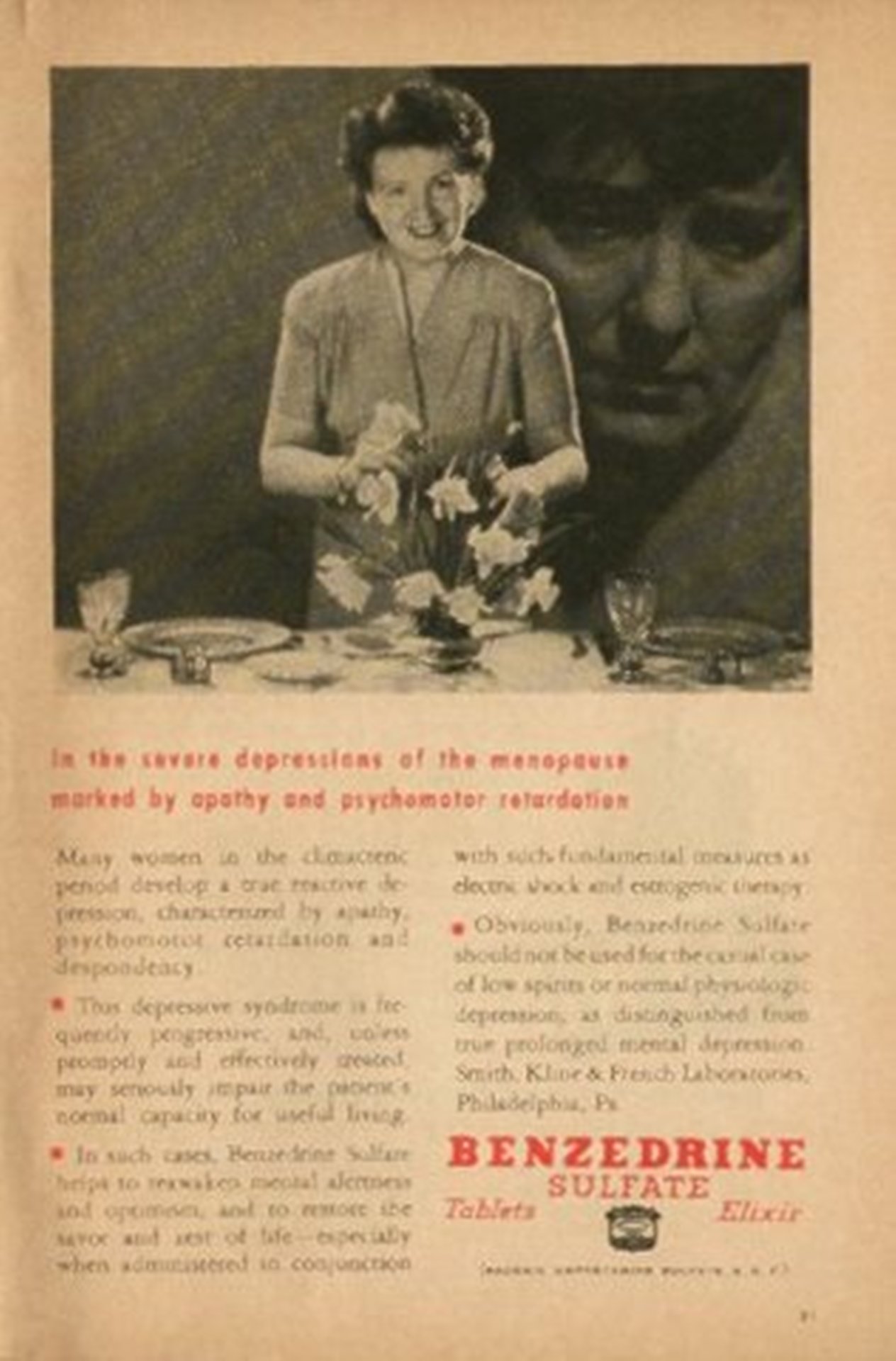
Read More“Severe depression? Apathy? Psychomotor retardation?” How about a bennie?
Every now and then, a post deserves a second viewing. This week, I’m bursting the bubble again on vintage advertising. Nothing like an upper for the mid-week blues, right?
“In the severe depressions of the menopause, marked by apathy and psychomotor retardation…”just use a bennie. You’ll be speeding through your day in no time! (And will probably lose that extra weight too!)
Really! What WERE they thinking?!
When was the last time you slept

…like a baby?
Yawning again? It’s not daylight savings time, promise! In fact, it may very well be your mood, at least in part.
I’ve been writing about sleep (or lack thereof) and menopause since first starting this blog in 2008. Click on the link and you’ll see posts about causes, solutions, pillows, sheets, you name it. And yet, I wouldn’t be surprised if sleep eludes you from time to time as much as it does me. More importantly, I imagine that some of you in the Flashfree universe don’t sleep much at all.
What gives?
Anxiety. And depression. That’s what. At least according to new data appearing in the online version of Maturitas journal. This time, researchers in search of some answers about sleep difficulties in midlife examined medical records of 237 women in peri- and postmenopause, all of who were on average, 52 years old. More specifically, they delved into answer that the women had provided to previous questionnaires about their life quality (based on physical and mental health, life satisfaction and social involvement) and degree of anxiety and/or depression. Within these questionnaires were measures of menopause-specific symptoms as well as sleep issues, including difficulty falling asleep and sleep that was non-restorative.
Overall, and unsurprisingly, about 36% of the women expressed difficulty falling asleep and 44% nonrestorative sleep during at least half the week. Almost a third experienced both issues at least 3 nights a week. Yet, sleep difficulties were less associated with menopausal symptoms (night sweats, hot flashes, nausea, dizziness, muscle/joint pain, headaches) and rather, with psychological statse of being. Indeed, trouble falling asleep seemed to be mostly correlated with anxiety, while non-restorative sleep was linked to depression.
This is not the first time that researchers have linked mood disorders to sleep issues. And although the progression is not entirely clear, i.e. the time course over which depression and anxiety develop during the transition to influence sleep, what is clear is that treating the underlying issues may ultimately help improve sleep quality.
What about you? Do you find that feeling blue or anxious tends to rob you of much needed zzzs? Or are you more convinced that waking up drenched in sweat is what is messing with obtaining restorative sleep?
Inquiring minds…
Read MoreShaken. Not Stirred.
I have been inspired by my friend Gini Dietrich’s weekly Gin and Topics posts over at Spin Sucks, so much so that I’ve decided to up the ante and bring back a Roundup-like feature to Flashfree (if you’re unfamiliar with the Roundup, think monthly highlight recaps. You can find them here.)
Shaken. Not Stirred is intended to highlight a few choice finds that I believe are worthy of mention in this space. They might not warrant an entire post, but they’ve shaken me up in one way or another to break (or pause, if you will) from our normally scheduled programming and deliver information in a format that is distinct from what you’ve come to expect. In that vein, this feature won’t appear on a regular schedule as I do believe that into every blog should flow a bit of the erratic; after all, that’s what keeps things lively, right?
So, without further ado… I bring you the Shaken. Not Stirred.
Bottom’s up!
- There’s a new kid in town and you may want to get to know him better. So you chat about him online with your other online pals, weigh his pros and cons. And then decide collectively whether or not to befriend him. That’s what the new patient portal Treato is doing. Only this time, the new kid is a medication you might be considering taking for your menopause-related depression and you’re not sure about its side effects. Can you find someone just like you to talk to about it, read/hear their experiences, obtain advice from a medical expert who might be weighing in and then make a more informed decision? Treato is doing just that in one consolidated location. Granted, I’ve not thoroughly vetted the site for accuracy and like any medical information that circulates on the web, ‘whatever is received’ requires vigilance on the part of the user. But I am a huge advocate of leveling the healthcare playing field and patients should be participating in their healthcare. Check it out. And let me know what you think.
- Who knew that weight loss could be so easy? One pair of Zaggora HotPants can help you zap away that unsightly cellulite. How? By incorporating “a comfortable bioceramic material that emits infrared rays to help wearers naturally and efficiently amp up weight-loss regimens. The shorts’ Celu-Lite technology smoothes thighs and other dimple-prone areas by galvanizing the skin’s internal zamboni to promote a deep warming of body tissues and promote lymphatic drainage. This process boosts sweating by up to 80% and aids in eliminating the toxins responsible for cellulite. Gotta give the company props for the term ‘internal zamboni’ but the reality is that nothing has been scientifically proven to rid the body of cellulite.
- Since we are on the topic of do’s and don’ts, why not end this week’s Shaken. Not Stirred with a bit of alcohol-related news? My guess is that many of you have seen the news about drinking and breast cancer and are as confused as I’ve been. My friend Elaine Shattner, over at Medical Lessons Blog, has done an excellent job distilling the facts down to ‘what you need to know,’ much better than I ever could have. Like me, Elaine (who is a trained oncologist, among other things) agrees that women no longer need to be stigmatized by their decisions, writing “Women, in my experience, are generally more vulnerable to the put-downs of others. And so my concern about the BC-alcohol link is that this will, somehow, be used, or have the effect of, making survivors or thrivers or women who haven’t even had breast cancer feel like they’re doing the wrong thing if they go to a party and have a drink. And then they’ll feel badly about themselves.” Do yourselves a favour: read this post.
And if you would, can you do me a favour and weigh in on Shaken. Not Stirred?
Yay, nay or meh?
Read More
Wednesday Bubble: Timeout

Back in 2009 I posted a story about a woman’s death being blamed on menopause. It seems especially poignant a day after World Menopause Day, a day unlike any others, when we put down our prejudices and celebrate everything menopause.
As my grandmother would say “oy vey.”
How about we focus on how, as women, we are constantly manipulated by ‘disinterested’ parties? How about we call “timeout?”
A bit of context…
In 2009, the BBC ran a story about a woman who committed suicide. The headline read:
“Woman’s Death Blamed on Menopause.”
“A woman who refused to take hormone replacement therapy died while suffering a menopausal episode, an inquest had heard. Margaret Drew…was killed when she walked out of her family home on to a nearby railway line and was hit by a train…There is no trigger to this at all, except hormones making her do things that she normally wouldn’t do, Dr. Carlyon [Cornwall Coroner) concluded…”
Menopause. The silent killer. Oh really? Drew’s husband claims that his wife was “delightful, lovely and friendly” 99% of the time; the other 1% she’d become “totally irrational.” Yet, she refused to try HRT, he says. On the day of her suicide, he said that his wife was “clearly angry about something.”
Something.
Obviously, the conclusion is that that the “something” is hormones. This reminds me of vintage advertising copy that conveys the simple message that a pill a day can cure all that ails, wipe away the tears, mood swings and instability so that women can “transition without tears” (or better yet, without killing themselves).
Notably, a search in the National Library of Medicine’s PubMed database turned up only one recent study specifically dealing with suicide ideation across reproductive stages. In it, researchers compared data in 8,794 women, and found an increased risk of thinking about suicide among women during perimenopause, not before or after entering menopause. These findings remained after controlling for risk factors such as anxiety and mood disorders. HOWEVER, the researchers noted that the study design did not allow them to form any definitive conclusions about the specific reasons for thinking about suicide.
Another search yielded information that the risk for a major depression increases during perimenopause, primarily as the direct result of vasomotor symptoms. The same does not hold true for women before menopause begins or once they enter menopause. Note that while major depression is a risk factor for suicide, not everyone who is depressed will actually kill themselves.
Are hormonal fluctuations the sole cause of such deep unhappiness that women want to kill themselves? Or their careers?
Let’s look at a more recent story that appeared this week in the Denver Post.
“Former Elbert County assessor blames menopause medications for crimes, is sentenced to 60 days in jail, fined $10,000”
“Elbert County Judge Jeffrey Holmes might have thrown the book at former county assessor P.J. Trostel just for her management skills alone. Instead, he sentenced Trostel today to 60 days in county jail, three years of probation and 200 hours of community service on two felony counts…In asking for leniency, Trostel and her lawyer said a variety of factors led her to make bad decisions. Those included depression, symptoms from menopause, medications and stress from family and work. “Some of the things I don’t even have an answer,” Trostel said. “I know I made terrible judgments and decisions.”
It sounds as though Trostel would have done better with different legal representation. And a sounder argument.
And while Trostel is chewing on that concept for the next six years while incarcerated, perhaps we can start to change the paradigm and focus on the ills of the Menopause Industrial Complex, disinterested parties who perpetuate societal myths that menopause is a disease that requires treatment and that as women, our attitudes, belief systems and actions are hormonally-based and driven. That we are hysterical beings who need guidance on how to find our way and fulfill our dreams, realize our paths, but only if we calm down. That we can’t hold a job down, keep a marriage intact or play nicely with others. That we need a timeout (this would entail a long, long time, by the way).
Seriously though, a timeout from the hype would be a welcome addition to the change, don’t you think?
Read More
Archives
Tags

This work is licensed under a Creative Commons Attribution-NonCommercial-NoDerivs 3.0 Unported License.